Just mercy
Just MercyJust mercy is a practice of justice grounded in hope and freely offered compassion, especially to people who have not earned or requested it. In the book, it does not erase responsibility or the pain of those harmed; it asks whether punishment alone can answer that pain, and whether care can interrupt the cycle of injury, retaliation, and further suffering.
Meaning and moral tension
The expression takes shape in the contrast between two webs: one of hurt and brokenness, and another of healing and mercy. The first includes violence, abuse of power, and mass incarceration; the second becomes possible when people respond to suffering without reducing anyone to a single act or a single role. Mercy is most consequential, the narrator argues, when it is least expected—not as a reward for deserving conduct, but as a way to break the movement from victimization to retribution.
That claim depends on holding harm and humanity together. The account of Ian Manuel does not minimize his reckless crime: he shot Debbie Baigre. Yet the book also shows him as a thirteen-year-old with serious problems, little supervision, and little help, later confined in solitary for eighteen uninterrupted years. Mercy here requires neither forgetting the shooting nor treating the conditions imposed on Ian as beyond moral scrutiny.
Victims, families, and the need for care
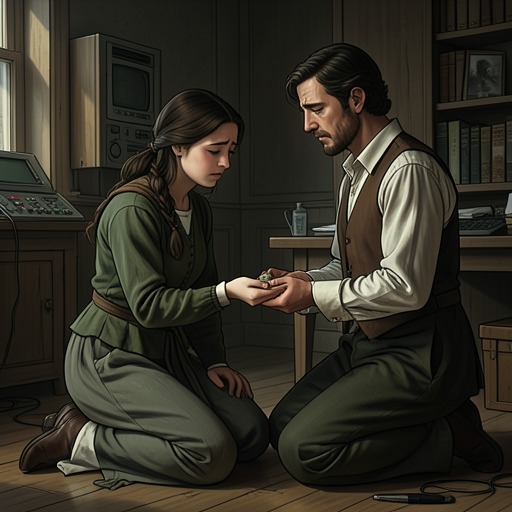
After a hearing for Herbert Richardson, the narrator encountered a group of Black women and children waiting in the courtroom. One woman identified herself as Rena Mae’s mother and explained that the family had been promised help that never arrived. She described hearing problems affecting MaryLynn since the bomb, nerve problems affecting another daughter, and similar problems of her own. She approached the lawyer representing Herbert Richardson because the family needed assistance. The exchange brings the victim’s relatives into the same scene as the person facing execution: the family’s needs remain real even though the lawyer’s role in that case is to defend the accused. The narrator took the woman’s offered hand and apologized that the promised help had not come.
Debbie Baigre’s response to Ian’s crime develops the same tension over a longer span. On Christmas Eve in 1992, during his monthly phone call, Ian reached out to the woman he had shot and apologized with deep regret. Baigre had physically recovered and was pursuing bodybuilding and a women’s-health magazine; she had not let the shooting derail her goals. Their unexpected call became a regular correspondence. In the isolation where Ian met few prisoners or correctional staff, she became one of the few people encouraging him to remain strong.
After years of communicating with Ian, Baigre wrote to the judge who had sentenced him, challenged the severity of his sentence and the inhumanity of his confinement, approached prison officials, and spoke to the press. She acknowledged the destructiveness of his crime while emphasizing that he had been a child, thirteen years old, without supervision or available help. The courts ignored her appeal for a reduced sentence. Her advocacy does not make her responsible for Ian’s welfare or undo what happened to her; it shows that a victim can speak clearly about the crime and still oppose the treatment of the person who committed it.
Grief beyond punishment
The book also recounts a grandmother whose sixteen-year-old grandson was murdered by other boys. She attended their trials, cried through nearly two weeks of proceedings, and watched them receive prison sentences that would keep them away forever. She had expected the convictions and sentences to make her feel better, but they made her feel worse. The punishment had not relieved her grief.
What she remembered instead was an unnamed woman who came to her after sentencing, embraced her, and let her lean on her. They sat together for almost two hours; for well over an hour, neither spoke. The grandmother never learned who the woman was, but she remembered that the quiet companionship made a difference. This small act does not resolve the murder or diminish the boys’ responsibility. It offers a different kind of response to the bereaved: presence and support where a verdict could not supply comfort.
Forgiveness, limits, and significance
Walter McMillian’s case gives the expression its clearest account of forgiveness directed toward people who have not deserved it. The narrator says that McMillian forgave those who falsely accused him, those who convicted him, and those who judged him unworthy of mercy. That forgiveness helped him recover a life worth celebrating, including love and freedom after wrongful condemnation. Mercy appears here not as acquiescence in injustice, but as part of a life that could outlast the injustice done to him.
The book does not present that recovery as a complete repair. After Walter McMillian’s release, no one was prosecuted for Ronda Morrison’s murder, and the narrator reflects on the anguish that this continued to cause her parents. The unresolved loss stands beside McMillian’s freedom: mercy toward the wrongly accused cannot substitute for justice for the victim or erase the family’s unanswered grief.
Across these episodes, Just mercy names an ethic that keeps multiple injuries visible at once. It asks for attention to victims and families, honest recognition of wrongdoing, humane treatment of people in custody, and hope that a person or community can change. Its force lies in refusing the premise that suffering must be answered with more suffering. The book presents compassion not as an escape from justice, but as a means of interrupting the cycle of victimization and retribution and making healing possible.